
Global Value Chains are complex networks that facilitate the capitalist globalization of production by siting low-priced labour-intensive production processes in less developed countries and highly-priced processes in the global north. Global value chains have been a dominant form of trade for the past three decades, and look set to continue despite starting to face challenges, ironically from the centre of capitalism itself.
1. Theft of value in GVCs
Chart 1: Wages, Value and price formation along the Global Production Chain
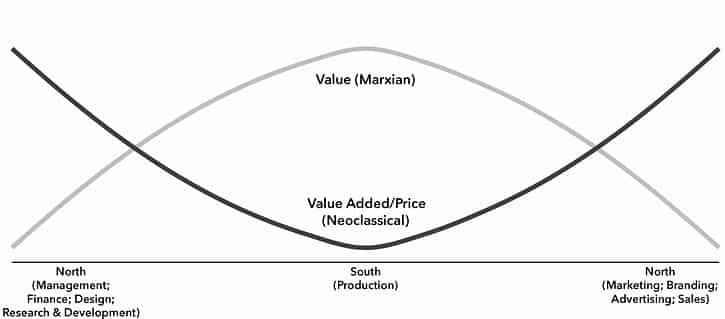
i. The chart1 above shows two contrasting curves. The ‘smiling curve’ shows how prices are assigned by lead firms in the global north, which set up and control the value chains. It shows how GVC production processes carried out in the north such as design, R&D, and, marketing, advertising and sales are assigned very high prices (value added), and manufacturing the lowest price. This arrangement translates into starvation wages for labour in the South and fabulous profits for corporations of the North. The other curve is based on Marx’ labour theory of value which sees labour as the sole producer of value, and thereby assigns the highest value addition to manufacturing. This contradiction in the assignment of price is the primary fault line in the GVCs.
ii. To illustrate, a buyer firm in the United Kingdom buys T-shirts produced in a garment factory in Bangladesh for £1 a garment, and retails them to consumers in the UK for £202 each. Labour in Bangladesh contributes the bulk of the surplus value but receives a fraction of the £1 paid by northern capital to the Bangladeshi businessman (who incidentally is also grossly shortchanged by the GVC system!).
iii. Ironically, a value of £19, most of which is not domestically produced, would be reflected in the GDP of the UK. Meanwhile, only £1 would appear in the GDP of Bangladesh where the T-shirt was entirely manufactured. This theft of value by the global north, is euphemistically termed ‘value capture’. Over the past 30 years of GVCs, imagine the massive flow of value from developing countries to the global north. The design of GVCs assures unabated capitalist accumulation from the exploitation of the resources of poorer countries.
2. Benefits of participating in GVCs
The World Bank promoted GVCs to developing countries as a model for attracting industrial capital as well as for upgrading indigenous technological capabilities, through the transfer of technology, and skills through exposure to Multinational Corporations (MNCs) in the production networks.
i. Participation in GVCs has undoubtedly led to a steep rise in industrialization in countries of the Global South. Their share of global manufactured exports rose from 5% in the pre-globalization period to 30% by the year 2000.
Chart 2 Global Industrial Workforce3
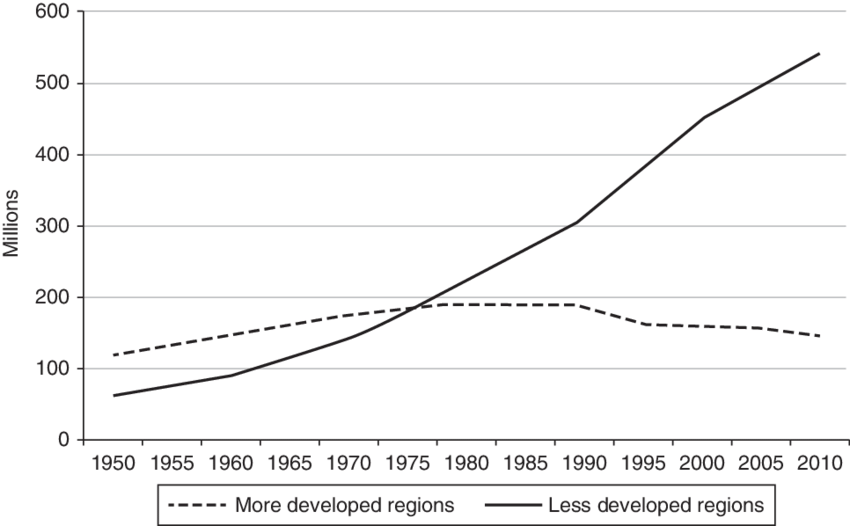
ii. There has been an enormous growth of industrial employment in developing countries. In 1950, 34% of the world’s industrial workers lived in less developed countries, rising to 53% in 1980, and to 79% in 2010.
iii. Several developing economies have had moderate to impressive economic growth, infrastructure development and poverty reduction through their participation in GVCs.
The benefits of globalization however come at a huge cost to labour, the environment, and humanity at large.
3. Realities of capitalist globalization
Labour worldwide has paid a high price, with northern labour enduring job losses and a decline in living standards. Southern labour meanwhile, took over the jobs but as virtual slaves of northern capital, as evident in the following:
i. GVCs have opened up vast employment opportunities in less developed countries but at dirt cheap wages. The degree of exploitation is horrific. In 2012 the textile industry accounted for 45% of all industrial employment in Bangladesh yet only contributed 5% of its national income. This is in contrast to the 25% contributed by the remaining 55% of industrial employment.
ii. Extremely low prices are paid by northern firms to suppliers of commodities manufactured in developing countries. These suppliers are forced to compete among themselves, resorting to extreme cost cutting to win cheaply priced contracts offered by MNCs.
Cost cutting by suppliers inevitably leads to starvation wages and modern slavery conditions of work, such as long work hours stretching beyond legal limits, and unpaid work. The contractualization of permanent jobs, which takes away job security has become common, along with informal work done mainly by women in the confines of the home, where work is extracted at a pittance from entire families without any social protection.
Workers’ lives, their health and safety, are severely compromised due to cost-cutting by supplier firms squeezed by buyer firms. Some examples:
– More than 1,100 garment workers were killed in the 2013 Savar building collapse in Bangladesh’ Cox Bazaar because the local suppliers continued operating their factories despite the building being certified unsafe after cracks appeared.
– Logistics companies in Malaysia routinely postpone spending on vehicle maintenance, using tyres that are not roadworthy, thus putting at risk the lives of lorry drivers and road users.
– Migrant workers from the region hired to work in Malaysia regularly endure months and months of non-payment of wages, wage theft, long work hours, and overcrowded living conditions.
iii. Environmental laws are not complied with due to cost cutting by local suppliers and lax enforcement, resulting in adverse environmental consequences such as air and water pollution. But environmental degradation in the south seems to be an externality that doesn’t appear in the accounting of northern firms.
iv. Export-led globalization over the years has made the economies of developing countries dependent on the global north. They have become vulnerable to policy changes in buying countries as has been abundantly clear in the jittery reaction of governments that have been reduced to beggars appealing Trump’s tariff hikes.
v) Contrary to World Bank promises, there has been stunting of technological capacity, with developing countries just borrowing and using technologies developed in the advanced countries. This is evident in the fact that the whole of SE Asia with a population of 680 million didn’t produce a single Covid vaccine of their own. In contrast, Cuba with a population of 10 million produced 3 Covid vaccines. So much for technology transfer through participation in the global value chains!
vi) Developing countries have been entrapped in regional Free Trade Agreements that whilst tying the hands of governments, strengthen MNCs with laws on capital transfer, patents, and legal protection through the ISDS regimes etc. Developing countries have lost a lot of control over their own economies.
4. The way out of the dystopia of globalized production
We live in a dystopian world today, where massive wealth produced in the developing countries is sucked up by corporations in the north through a system of trade that is given legitimacy by institutions such as the IMF and World Bank. The greater mass of humanity lead wretched lives, working long hours, enduring oppressive working conditions, and receiving wages that are a minute fraction of the wealth they create. Their physical and mental health and well-being are violated by this system which is also destroying the planet with its uncontrolled growth imperative.
The dystopia globalization has led us to is neither normal nor human, and needs to be rejected. An alternative globalization needs to be advanced, one built on solidarity, with its emphasis on the development of a more equal and humane society, and, respect for and preservation of the planet.
This alternative will require developing countries to adopt a new paradigm where the South is economically and technologically independent of the imperialist North. In line with this, the current export-led industrialization of developing countries should be gradually replaced with import substitution, and the development of R&D and technology prioritized.
Countries of the global South could develop regional markets like ASEAN which has a total population of 680 million people – double that of the US – and gradually pivot away from the markets of the global North.
Who will lead this transformation? Will BRICS with its yet undefined ideology place people and the planet before profits? What is certain is that people’s movements have a major role to play, by setting aside differences, and coming up with a left pro-people globalization, and actively advance it to alternative international formations.
Rani Rasiah
Parti Sosialis Malaysia
References
1. Imperialism and the Transformation of Values into Prices by Torkil Lauesen and Zak Cope
2. Twenty-first century imperialism, multipolarity and capitalism’s ‘final crisis’: Interview with John Smith
By John Smith & Federico Fuentes
3. John Smith, Monthly Review, Jul-Aug 2015
4. Wikipedia